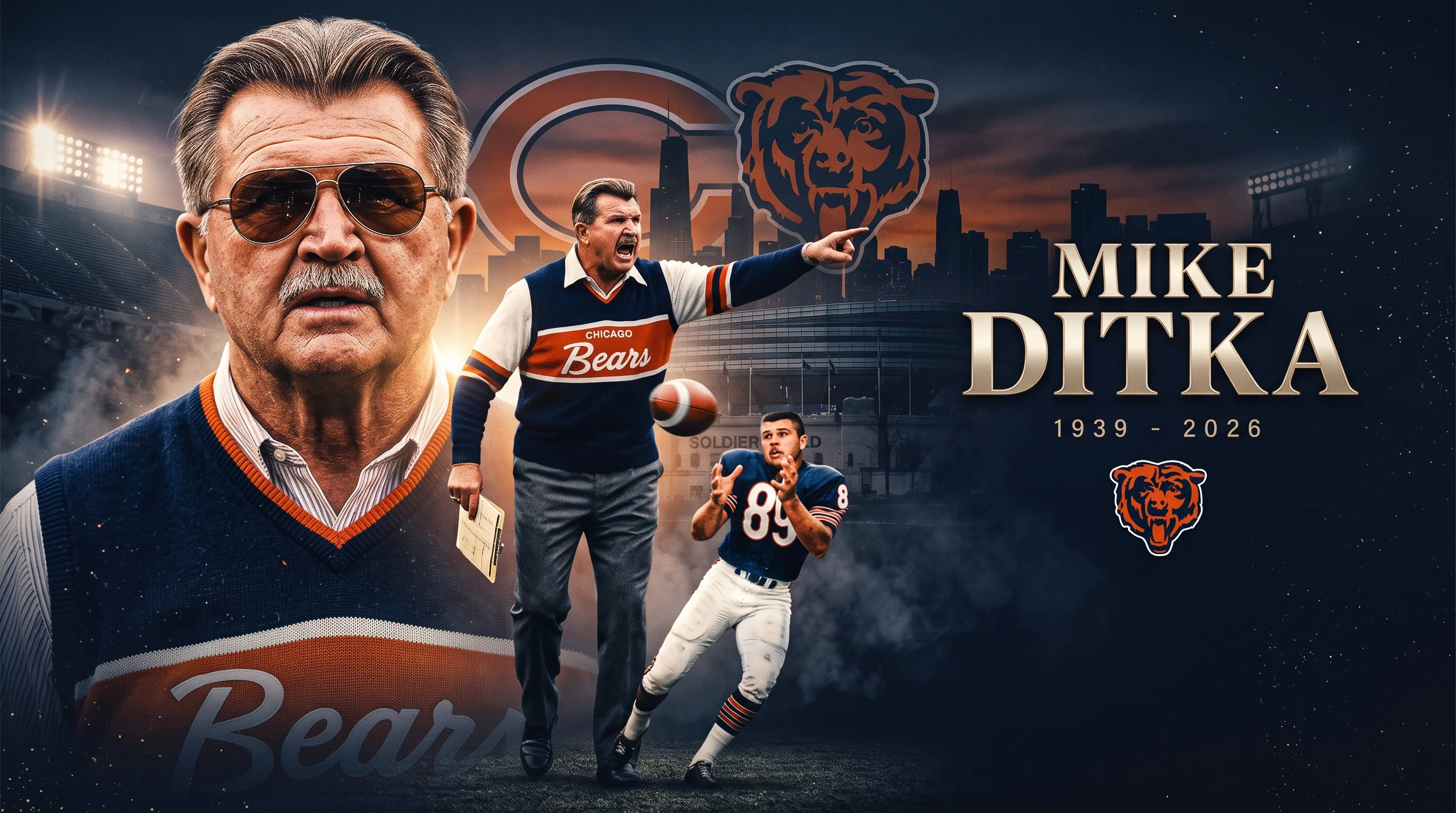
Mike “Iron Mike” Ditka
Player. Coach. Champion. The unforgettable force behind one of the most celebrated teams in NFL history—and a defining figure in Chicago football.
Few people have influenced professional football from as many perspectives as Mike Ditka. A Hall of Fame tight end, a Super Bowl-winning assistant coach, and the head coach who led the 1985 Chicago Bears to their championship, Ditka became one of the NFL’s most recognizable personalities.
His legacy reaches beyond wins and losses. It reflects the evolution of the tight end position, the identity of a city, and a championship team whose story became part of American sports culture.
From Pennsylvania to the National Football League
Michael Keller Ditka was born on October 18, 1939, in Carnegie, Pennsylvania, and grew up in nearby Aliquippa. The region’s working-class culture and emphasis on toughness became part of the public image he carried throughout his football career.
At the University of Pittsburgh, Ditka developed into one of college football’s leading players. He combined strength and blocking ability with the receiving skills needed to create mismatches against opposing defenses.
In 1960, he earned consensus All-American recognition. His college performance helped establish him as an unusually versatile prospect before the Chicago Bears selected him with the fifth overall pick in the 1961 NFL Draft.
Why his background matters
Ditka’s style reflected an era when physicality was central to football. His willingness to block, absorb contact, and make catches over the middle helped define the tough, all-purpose tight end.
The Tight End Who Changed Expectations
Tight ends have traditionally served two roles: helping protect the quarterback and creating opportunities in the passing game. Ditka demonstrated how valuable the position could be when a player excelled at both.
A remarkable first season
In 1961, Ditka recorded 56 receptions for 1,076 yards and 12 receiving touchdowns in 14 games. He earned NFL Rookie of the Year honors and became one of the league’s most exciting young offensive players.
His 1,000-yard rookie season was an extraordinary achievement for a tight end. It remains an important milestone in the history of the position, even as modern offenses and training methods have changed the game.
Career receiving statistics
| Statistic | Career total |
|---|---|
| Games played | 158 |
| Receptions | 427 |
| Receiving yards | 5,812 |
| Receiving touchdowns | 43 |
| Yards per reception | 13.6 |
| Longest reception | 76 yards |
| Pro Bowl selections | 5 |
Statistics refer to Ditka’s NFL regular-season playing career.
His First Six NFL Seasons
Ditka’s rookie year was extraordinary, but his production continued through his early seasons in Chicago. The following graphic compares his regular-season receiving yards from 1961 through 1966.
Source: NFL career statistics. Bar lengths are scaled to the highest season shown: 1,076 receiving yards in 1961.
What stands out?
Ditka surpassed 900 receiving yards in each of his first two seasons. In 1964, he recorded a career-high 75 receptions and finished with 897 receiving yards and five touchdowns.
A Player Becomes a Champion
Ditka played for the Chicago Bears from 1961 through 1966, the Philadelphia Eagles in 1967 and 1968, and the Dallas Cowboys from 1969 through 1972.
His move to Dallas placed him in a championship organization led by head coach Tom Landry. The experience would prove significant when Ditka later transitioned from playing to coaching.
Super Bowl VI
The Dallas Cowboys defeated the Miami Dolphins 24–3 in Super Bowl VI in January 1972, following the 1971 season. Ditka was a member of that championship team.
He retired as a player after the 1972 season, but football remained central to his life. He returned to Dallas as an assistant coach and began a new chapter in his career.
The Rise of the Chicago Bears Dynasty
As an assistant coach with Dallas, Ditka worked under Tom Landry and was part of the Cowboys staff that won Super Bowl XII after the 1977 season. That championship gave him valuable experience in a highly successful organization.
In 1982, Ditka became head coach of the Chicago Bears. He brought an intense, demanding leadership style to a franchise with a proud history and a devoted fan base. The defining achievement of his tenure came in the 1985 season.
The legendary 1985 Bears
Chicago finished the regular season 15–1 and won three postseason games to complete an 18–1 campaign. The team paired a dominant defense with a powerful running game and a roster full of memorable personalities.
Super Bowl XX · January 26, 1986 · Chicago won its first Super Bowl.
The Bears defeated the New England Patriots 46–10 in Super Bowl XX. The defense overwhelmed New England, and Chicago completed one of the most celebrated championship runs in NFL history.
More than a championship
The 1985 Bears became a cultural phenomenon. Their personalities, confidence, and television appearances helped turn the team into a national story.
“The Super Bowl Shuffle,” released during the championship season, became one of the most recognizable songs associated with a sports team. The Bears were not simply winning games; they were becoming part of popular culture.
A key historical distinction
The team is known as the “1985 Bears” because of the season it played. Super Bowl XX took place in January 1986, when Chicago defeated New England for the championship.
The Milestones That Defined His Journey
Born in Pennsylvania
Born October 18 in Carnegie, Pennsylvania, and raised in the nearby Aliquippa area.
College All-American
Earned consensus All-American recognition at the University of Pittsburgh.
A historic NFL debut
Selected fifth overall by the Chicago Bears and recorded 1,076 receiving yards as a rookie.
NFL champion with Chicago
Helped the Bears win the NFL Championship during his playing career.
Super Bowl champion as a player
Won Super Bowl VI as a member of the Dallas Cowboys.
Champion as an assistant coach
Was part of the Dallas coaching staff that won Super Bowl XII after the 1977 season.
Returns to Chicago as head coach
Took charge of the Bears and began building the team that would define his coaching legacy.
The Super Bowl XX championship
Led the 15–1 Bears through the playoffs to a 46–10 Super Bowl victory.
College Football Hall of Fame
Was inducted into the College Football Hall of Fame.
Pro Football Hall of Fame
Was inducted into the Pro Football Hall of Fame, becoming the first tight end to receive that honor.
New Orleans Saints
Returned to head coaching with the Saints after his tenure in Chicago.
A lasting legacy
Ditka died at age 86, leaving behind a career that spanned championship football as a player, assistant coach, and head coach.
Why Mike Ditka Still Matters
Ditka’s career was unusual because he succeeded in three distinct football roles. He experienced championship football as a player, as an assistant coach, and as a head coach. Few figures are so closely connected to all three perspectives.
His playing career crossed an important period in the development of the tight end position. His coaching career helped define the identity of one of the NFL’s most memorable teams. Later, his broadcasting work kept him in the public eye long after he left the sidelines.
A Hall of Fame tight end
His receiving production and physical style helped establish a lasting standard for the position.
A championship leader
His Bears teams combined intensity, a powerful defense, and a clear identity that fans still remember.
A voice of football
His direct manner and recognizable presence made him a familiar figure to sports audiences across generations.
A lasting Chicago connection
For many Bears fans, “Da Coach” remains inseparable from the unforgettable 1985 championship team.
Lessons from Da Coach
01. Redefine your role. Ditka’s versatility showed how mastering multiple responsibilities can make someone more valuable.
02. Build a team identity. The Bears became memorable not only for individual talent, but for a recognizable collective spirit.
03. Adapt to new challenges. Moving from player to assistant coach to head coach required different skills and leadership.
04. Leave a lasting impact. A legacy is built through achievements, the people influenced, and the memories that endure.
The Numbers Behind the Leadership
Across his regular-season head-coaching career with Chicago and New Orleans, Ditka recorded 121 wins and 95 losses. His Bears tenure produced the championship season that became the defining chapter of his coaching story.
Coaching figures above refer to regular-season head-coaching results, not postseason games.
Explore the Original Records
These official resources provide additional information about Ditka’s playing statistics, coaching career, and place in football history.
- NFL.com — league history, records, and player statistics.
- Pro Football Hall of Fame — player biography and Hall of Fame history.
- College Football Hall of Fame — college football history and honors.
- Chicago Bears — franchise history and team coverage.
This is a historical tribute. Verify statistics and biographical details against the original records before publication.
Comments (0)