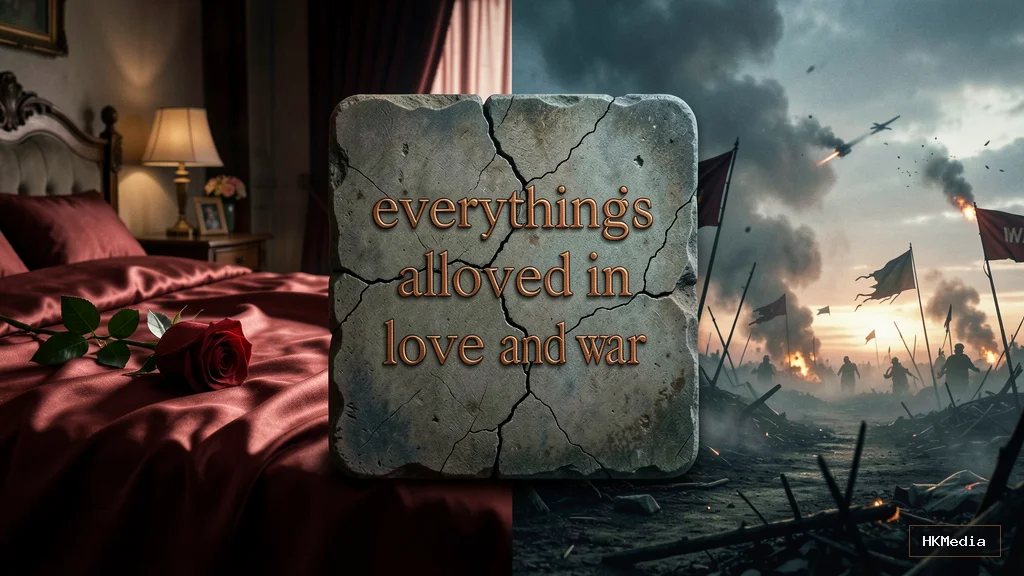
Few phrases capture the tension between desire and morality as starkly as “everything is allowed in love and war.” At first glance, it sounds like a license to abandon scruples when the stakes feel existential. Yet beneath the bravado lies a deeper inquiry: when, if ever, can we justify setting aside the rules that govern civilized life?
Historical Roots of the Saying

The idea traces back to the late 16th century. English poet John Lyly wrote in Euphues: The Anatomy of Wit (1579) that “any impiety may be committed in love, which is lawless.” Over centuries, the wording shifted, but the core sentiment persisted: in the pursuit of love or victory in battle, conventional ethics may be suspended.
Why Love and War?

Both domains are portrayed as zero‑sum games where the outcome feels all‑consuming. In love, the fear of rejection or the intensity of passion can make rational restraint seem like defeat. In war, survival and victory often appear to demand any means necessary. The proverb thus reflects a belief that extreme goals justify extreme methods.
Ethical Quandaries

If we accept that “everything is allowed,” we open the door to deception, manipulation, and even violence—provided the arena is labeled love or war. Critics argue that this erodes the very foundations of trust and cooperation that make society possible. Moreover, the distinction between legitimate strategy and outright cruelty becomes blurred.
Modern Manifestations
Today the phrase surfaces in contexts far from battlefields or boudoirs:
- Business: Aggressive tactics to win a market share or a promotion are sometimes excused as “all fair in love and war.”
- Politics: Negative campaigning, misinformation, and smear tactics are justified by claiming the electoral arena is a war.
- Digital Romance: Online dating sees “ghosting,” catfishing, and emotional manipulation rationalized as part of the game.
In each case, the proverb serves as a moral shortcut, allowing actors to avoid accountability.
Counterarguments: When Rules Matter Most
Proponents of strict ethics contend that love and war are precisely where humanity needs its moral compass the most. In love, trust and respect are the bedrock of lasting intimacy; in war, adherence to laws of armed conflict protects civilians and preserves the possibility of post‑conflict reconciliation. Abandoning rules risks producing hollow victories and broken hearts.
True strength lies not in winning by any means, but in winning without losing oneself.
Hesham Kholef
Allowing everything in love and war may win battles, but it often loses the war for our shared humanity.
Conclusion
The proverb “everything is allowed in love and war” endures because it captures a genuine human temptation: to let desire or fear override principle. Yet its persistence also invites continual scrutiny. By examining where we draw the line—and why—we affirm that the most meaningful victories, whether in the heart or on the battlefield, are those achieved with integrity intact.
Comments (0)