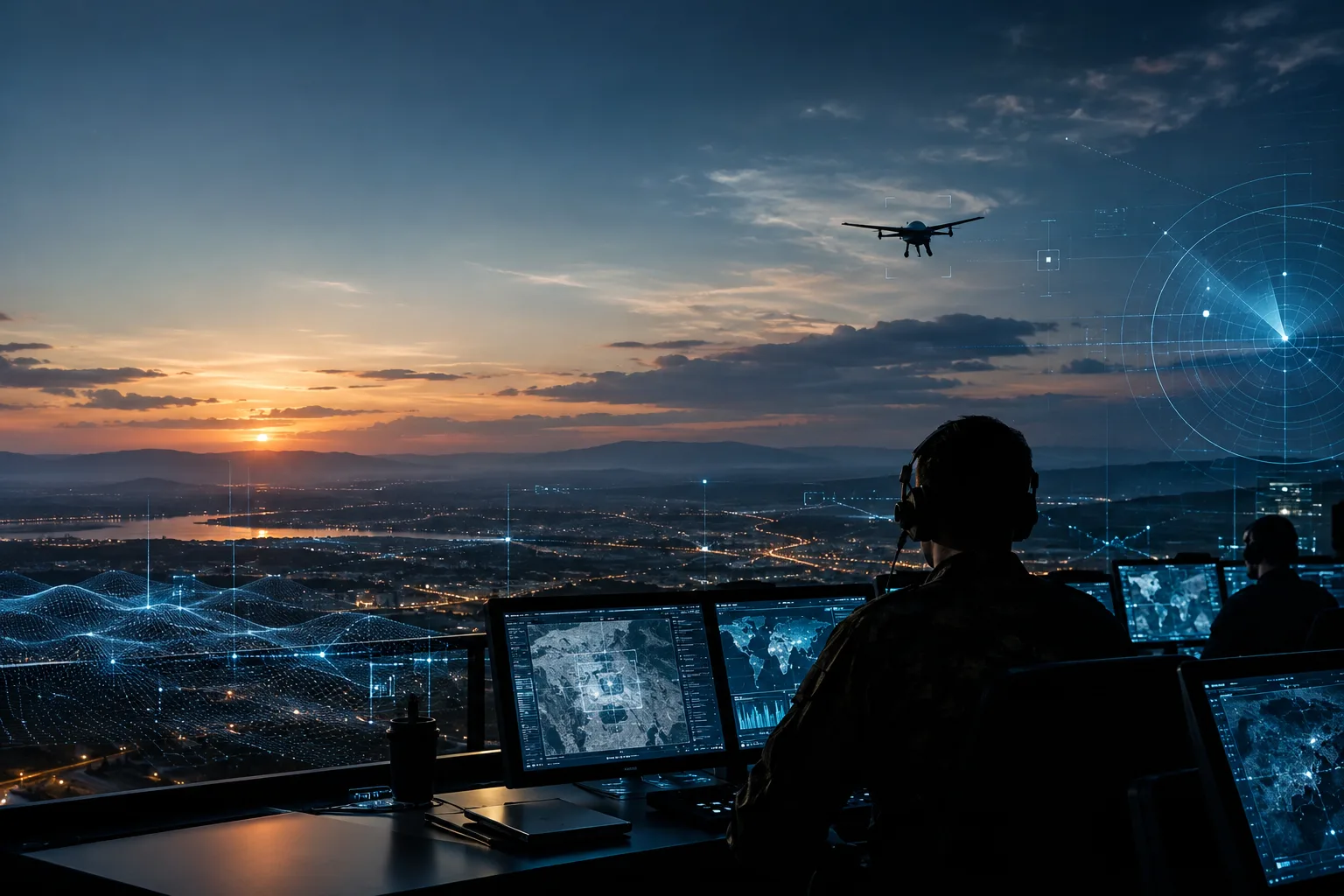
AI and the War to Come
How artificial intelligence is changing the battlefield—and why the most consequential decisions may still belong to us.
The article in brief
AI is becoming part of military intelligence, drone operations, cyber defence, logistics and information warfare. These capabilities can help people process information faster, but they also introduce risks involving unreliable data, automated escalation, civilian harm and accountability. The challenge is not simply to build smarter systems. It is to ensure that humans retain meaningful responsibility for how those systems are used.
The next major transformation in warfare may not be defined by a single weapon. It may emerge from the integration of thousands of connected systems—sensors, drones, satellites, software, communications networks and decision-support tools—working at a speed no individual human can match.
Artificial intelligence is not a single military technology, and it does not make every weapon autonomous. It is a broad collection of techniques that can identify patterns, classify images, summarize intelligence, forecast events and help coordinate complex operations. The implications depend on what a system is designed to do, how reliable it is, who supervises it and what happens when it fails.
That distinction matters. The future of war is not a simple story of machines replacing soldiers. It is a story about people, institutions and increasingly capable systems becoming more tightly connected—with consequences that can be difficult to predict.
1. The shift is already underway
Military organizations have long used automation, guided weapons, remote sensing and computer-assisted planning. Recent advances in machine learning and generative AI expand the range of tasks software can support, from interpreting surveillance imagery to helping analysts work through large volumes of information.
NATO's revised AI strategy, published in July 2024, explicitly addresses the adoption of AI, interoperability, testing and threats from adversarial use—including AI-enabled disinformation. This is an institutional recognition that AI is relevant to both military capability and the security of the information environment.
But a strategy document is not proof that every envisioned capability works reliably in combat. Real-world performance depends on the quality of data, communications, training, environmental conditions, testing and the ability of people to understand a system's limitations.
See more
AI can help sort images, sensor readings and reports, highlighting patterns that deserve human investigation.
Process faster
Decision-support systems can organize information and present options, but their outputs can still be incomplete or wrong.
Connect systems
Software can help different platforms share information, provided their networks and data formats are compatible and secure.
Act under pressure
Automation can shorten response times. It can also reduce the time available for verification, deliberation and de-escalation.
2. A battlefield measured in data
Modern military operations produce enormous volumes of information. A commander may need to consider aerial imagery, radar observations, intercepted communications, logistics reports, weather, friendly-force positions and intelligence from multiple sources.
AI can help analysts sift through that material and identify potential patterns. It may assist in recognizing objects in imagery, tracking changes over time or flagging unusual activity. When used well, these tools can reduce some of the burden on people who would otherwise need to review every data point manually.
However, a detected pattern is not necessarily a correct interpretation. An object can be misclassified. A sensor can be obscured. Information can be outdated, manipulated or stripped of context. A prediction can look precise while resting on uncertain assumptions.
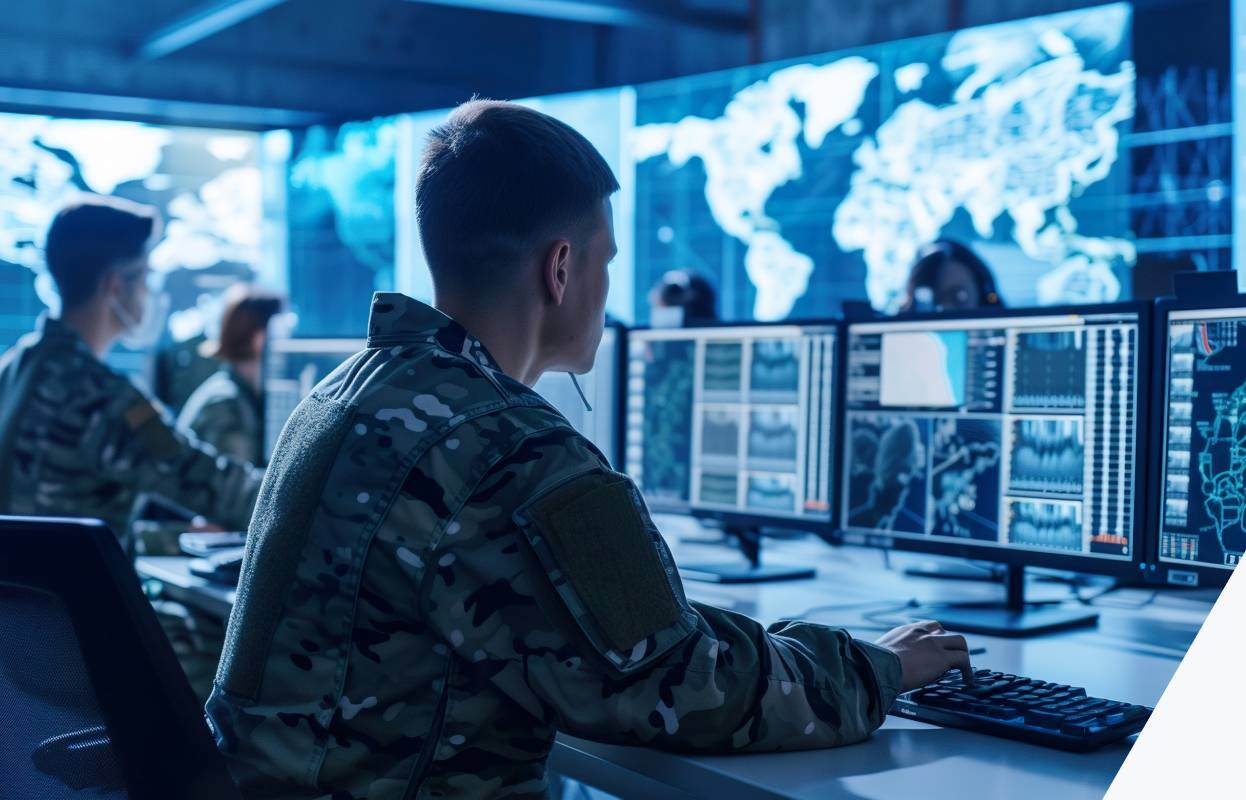
The most capable military organization may not simply be the one with the most AI. It may be the one that can combine good data, dependable communications, robust testing, trained personnel and sound judgment into a coherent system.
3. When weapons become more autonomous
One of the most consequential debates concerns autonomous weapon systems. The term does not describe every drone or every weapon with automated features. The International Committee of the Red Cross (ICRC) focuses on systems that, once activated, can select and engage targets without further human intervention.
This matters because there is a major difference between software that helps a person examine information and a weapon that selects a target and applies force on its own.
Autonomy can offer operational advantages in environments where communications are unreliable or a response must happen quickly. Yet it also raises difficult questions: Can the system distinguish military targets from civilians in a complex environment? Can its behavior be predicted? Can an operator intervene in time? Who is responsible if it behaves unexpectedly?

The ICRC's March 2026 briefing on autonomous weapons and international humanitarian law explains the humanitarian and legal challenges associated with increasing autonomy. The organization argues for new legally binding rules, including prohibitions and restrictions on certain systems.
The debate is not simply whether a machine can identify a target. It is whether the entire process can remain predictable, legally compliant and under meaningful human control in the circumstances in which it is used.
4. Cyberwarfare and the battle for truth
War is fought through information as well as physical force. Military networks, communications, logistics systems and critical infrastructure can all become targets. AI may help defenders identify suspicious activity, prioritize alerts and respond to certain threats. The same broad technological advances can also help malicious actors automate parts of reconnaissance, social engineering and content production.
Generative AI adds another complication: convincing text, images, audio and video can be produced or altered quickly. In a crisis, fabricated footage or a fake recording attributed to a political or military leader could create confusion before independent verification is possible.
That does not mean every viral clip is fake or that AI-generated content automatically changes the outcome of a conflict. The actual impact depends on distribution, credibility, audience behavior and the ability of trusted sources to establish what happened.
Resilience requires more than detection software. It also requires secure communications, transparent correction procedures, independent verification, media literacy and clear channels for sharing reliable information during emergencies.
5. The danger of machine-speed escalation
One of the most serious risks is not a machine independently deciding to start a war. It is a chain of human and automated decisions becoming faster, more interconnected and harder to interrupt.
Imagine a hypothetical crisis in which one side's surveillance system misinterprets an event. Its decision-support software flags a threat. Commanders under pressure respond. The other side observes that response and interprets it as preparation for an attack. Its own automated systems then recommend countermeasures.
No individual step needs to be intentionally reckless for the situation to deteriorate. The danger comes from uncertain information, compressed decision time, mutual suspicion and the difficulty of reversing actions once they begin.
This is a scenario, not a prediction that such a sequence will inevitably occur. It illustrates why verification, communication and human oversight matter even when automation improves speed.
| Potential advantage | Corresponding risk |
|---|---|
| Faster intelligence analysis | Incorrect assessments can spread through a decision chain more quickly. |
| Automated threat detection | False positives or misleading data can trigger unnecessary responses. |
| More connected systems | A compromised network or shared data error can affect multiple capabilities. |
| AI-assisted forecasting | Decision-makers may mistake probabilistic estimates for certainty. |
| Rapid communications | Manipulated content can circulate before reliable verification catches up. |
The lesson is not that speed is always dangerous. It is that faster action is valuable only when the surrounding system can distinguish reliable information from error and preserve opportunities for human intervention.
6. Why human judgment still matters
AI systems can classify, recommend, forecast and generate. Those capabilities do not make them moral or legal authorities. A model can estimate a probability, but it does not independently bear responsibility for the decision to use force.
Human responsibility must therefore be supported by more than a person nominally approving a recommendation. Operators need enough time, information, training and authority to challenge a system, reject its output or stop its operation when necessary.
The United States Department of Defense's January 2023 announcement updating Directive 3000.09 states that autonomous and semi-autonomous weapon systems should allow commanders and operators to exercise appropriate levels of human judgment over the use of force. The directive also addresses testing, reliability and compliance with applicable legal and policy requirements.
These are policy commitments, not a guarantee that every system will perform perfectly. They illustrate the need to make oversight an operational capability rather than a statement of principle.
The central question is not whether humans or machines are faster. It is whether the system preserves the judgment and accountability required when decisions affect human lives.
7. Rules, responsibility and the road ahead
AI in military settings is not outside the law. International humanitarian law continues to apply to the conduct of hostilities, including the rules governing distinction, proportionality and precautions in attack. The challenge is ensuring that the design and use of increasingly autonomous systems make compliance possible in real operational conditions.
The ICRC argues that existing rules do not resolve every question raised by autonomous weapons and calls for additional legally binding restrictions. NATO's revised AI strategy emphasizes lawfulness, responsibility and accountability, explainability and traceability, reliability, governability and bias mitigation.
These approaches differ in scope and emphasis, but both underline that technical performance alone is insufficient. Systems need appropriate limits, meaningful testing, security protections and clear accountability throughout their lifecycle.
- Define boundaries: Establish clear limits on what a system may do and the circumstances in which it may operate.
- Test realistic conditions: Evaluate performance against uncertainty, degraded communications, adversarial manipulation and unexpected environments.
- Preserve intervention: Ensure that responsible people can understand, pause or stop system behavior when required.
- Maintain accountability: Make responsibilities clear across procurement, development, command and operational use.
- Strengthen international dialogue: Develop shared expectations, risk-reduction measures and rules for the use of military AI.
International governance is difficult because states have different security concerns, strategic interests and views on the right level of autonomy. Yet the difficulty of reaching agreement is not evidence that agreement is unnecessary. It is a reason to focus on concrete risks, practical safeguards and verifiable commitments.
8. Three possible futures
The future of AI and warfare is not predetermined. Three broad paths illustrate the choices facing governments, militaries, technology companies and international institutions.
- Path one — Responsible integration AI helps people analyze information, protect networks and manage complex operations. High-risk applications face rigorous testing, meaningful oversight and clear legal boundaries. International communication reduces the chance that technical failures are mistaken for deliberate attacks.
- Path two — Competitive acceleration States race to deploy new capabilities. Testing and governance struggle to keep pace, while increasingly connected systems create new dependencies. AI improves some military functions, but uncertainty and escalation risks grow.
- Path three — Fragmented and unstable automation Capabilities spread across state and non-state actors, information becomes harder to verify, and safeguards differ widely. Unreliable systems, cyber interference and unclear responsibility compound the dangers of conflict.
These are analytical scenarios, not forecasts. Reality may combine elements of all three. Their purpose is to highlight a crucial point: outcomes depend not only on what the technology can do, but also on the institutions, incentives and rules governing its use.
Conclusion: The war will test more than technology
AI will continue to influence the tools available to military organizations. It can help process information, coordinate systems and support defensive capabilities. It can also magnify errors, complicate accountability, accelerate escalation and make deception cheaper to produce.
None of these outcomes is automatic. Technology does not determine strategy, and faster analysis does not guarantee wiser decisions.
The most important questions are therefore human ones. Who defines the limits? Who verifies the information? Who can intervene? Who is accountable when a system fails? And can rival states build enough trust and communication to prevent a technical incident from becoming a wider conflict?
The war to come may involve systems operating at machine speed. But the responsibility for how those systems are developed, deployed and governed remains a human responsibility.
The future of warfare will be shaped by artificial intelligence. The future of humanity will depend on whether our judgment, restraint and institutions can keep pace.
Sources and further reading
Primary institutional sources are prioritized below. They support the article's discussion of military AI policy, autonomous weapons and international humanitarian law.
- NATO — Summary of NATO's revised Artificial Intelligence Strategy. Official policy on AI adoption, responsible use, testing and adversarial threats.
- International Committee of the Red Cross — Autonomous Weapon Systems and International Humanitarian Law: Selected Issues, March 2026. Humanitarian and legal analysis of autonomous weapons.
- International Committee of the Red Cross — Autonomous weapons. Background on the ICRC's position and proposed international restrictions.
- U.S. Department of Defense — Update to Directive 3000.09, Autonomy in Weapon Systems, January 25, 2023. Official explanation of policy requirements for autonomous and semi-autonomous weapons.
- United Nations Secretary-General — Remarks to the Security Council open debate on AI and international peace and security, September 24, 2025. A statement on military AI, human control, international law and global regulation.
Editorial note: This article distinguishes current policy and established technical uses from potential risks and hypothetical scenarios. Military capabilities and regulatory positions evolve; confirm the latest official documentation before republication.
Comments (0)