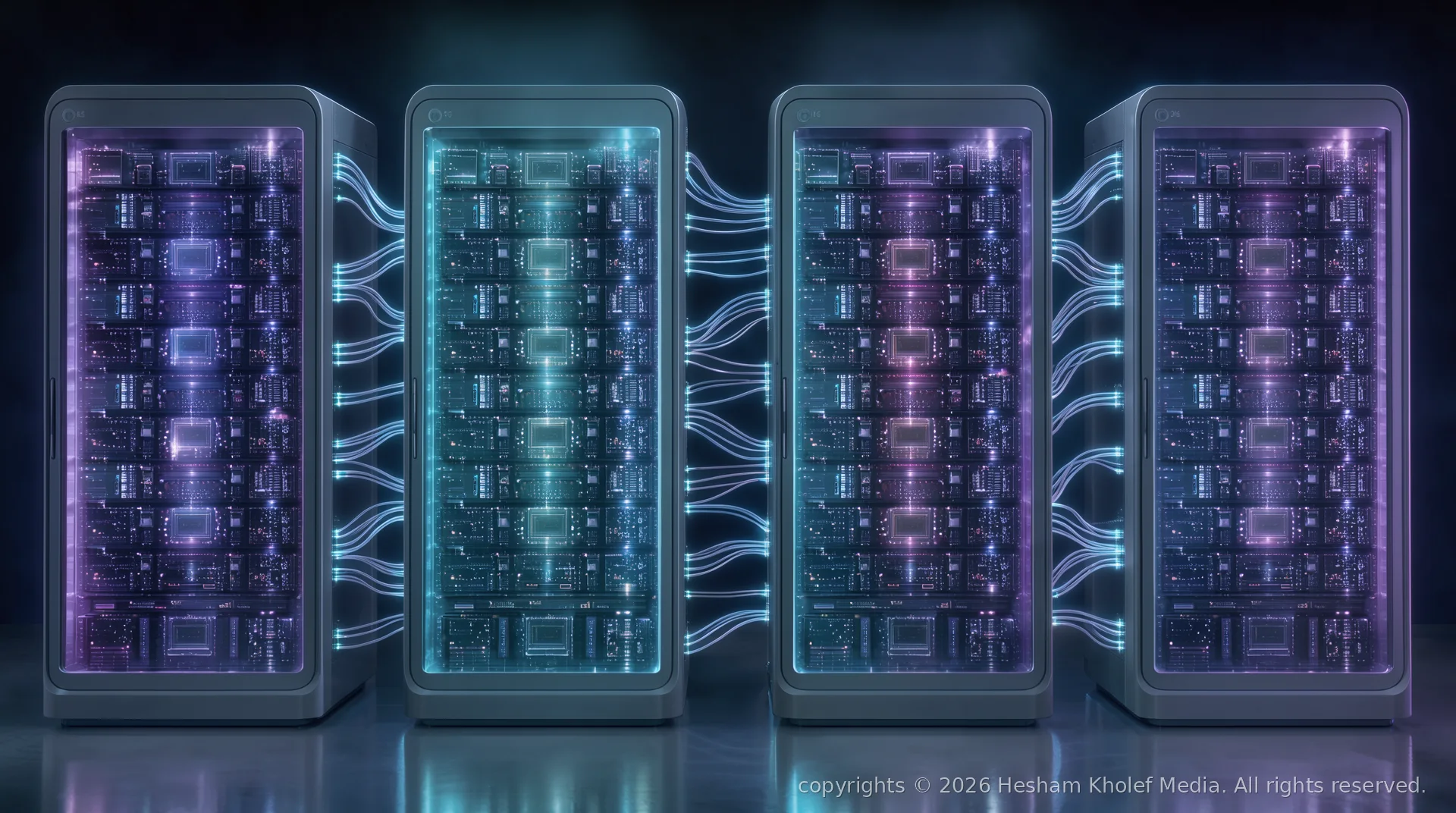
The Scalability Breakthrough: Four Racks, One Network

For decades, quantum computing's promise has been throttled by a stubborn reality: adding more qubits usually means adding more noise, more heat, and more intractable engineering. Xanadu's Aurora prototype, announced January 22, 2025, rewrites that narrative. The Canadian quantum hardware and software company has demonstrated a universal photonic quantum computer whose defining feature is not raw qubit count — it has 12 — but its architecture: four independent server racks, photonic-interconnected and networked into a single coherent system.
This modular design is the critical advance. Each rack operates autonomously, yet they are bound together by photonic links — light itself — allowing quantum information to flow between modules without the cryogenic plumbing or microwave interconnects that constrain superconducting approaches. The result: a blueprint that, in principle, scales to thousands of racks and millions of qubits.
Photonics at Room Temperature: A Practical Path Forward

Aurora's 12 qubits are encoded in squeezed states of light, manipulated by 35 photonic chips fabricated using established semiconductor foundry processes. The entire system runs at room temperature. There are no dilution refrigerators, no millikelvin cooling plants, no exotic vacuum chambers. Instead, 13 kilometers of optical fiber weave through the four racks, carrying quantum states between modules with low loss and high fidelity.
This reliance on commercially available photonic components — manufactured with mature CMOS-compatible techniques — is deliberate. It means Aurora's architecture isn't a laboratory curiosity; it's a prototype built from parts that can be sourced, scaled, and integrated into existing data-center infrastructure. As Christian Weedbrook, Xanadu's founder and CEO, put it:
"The two big challenges remaining for the industry are the improved performance of the quantum computer (error correction and fault tolerance) and scalability (networking). Xanadu has now solved scalability. Photonics really is the best and most natural way to both compute and network. We now could, in principle, scale up to thousands of server racks and millions of qubits, but first we will focus on performance in reducing loss and being fault tolerant."
— Christian Weedbrook, Founder & CEO, Xanadu
From X8 and Borealis to Aurora: An Evolutionary Lineage

Aurora did not emerge in isolation. It inherits the design philosophy of Xanadu's earlier photonic platforms: the X8 photonic quantum processor, accessible via the cloud, and Borealis, which in 2022 demonstrated quantum advantage on a Gaussian boson sampling task with 216 squeezed modes. Both systems proved that photonics could deliver programmable, large-scale quantum interference. Aurora integrates those lessons — modularity, measurement-based gate teleportation, real-time classical feedforward — into a networked, rack-mounted form factor designed for the data center.
The system supports gate operations, real-time error correction, and decoding within the practical constraints of quantum clock rates and classical control hardware. That last point is crucial: Aurora's control electronics keep pace with the photonic clock, enabling the fast feedback loops that fault-tolerant quantum computing demands.
- Architecture: 4 modular, independent server racks, photonic-interconnected
- Qubits: 12 (squeezed-state photonic qubits)
- Photonic chips: 35, fabricated via commercial foundry processes
- Interconnect fiber: 13 km of optical fiber linking modules
- Operating temperature: Room temperature (no cryogenics)
- Scalability target: Thousands of racks, millions of qubits
- Key capabilities: Gate operations, real-time error correction, measurement-based feedforward
The Road Ahead: Loss, Fault Tolerance, and the Quantum Data Center
Having cracked the networking problem, Xanadu has turned its focus to the other great challenge: optical loss. Every fiber junction, every chip coupler, every detector introduces attenuation. In a fault-tolerant regime, loss must be pushed below the threshold where quantum error correction can compensate — typically well under 1% per component. Aurora's 35 chips and 13 km of fiber represent a significant loss budget; reducing it is now the company's primary engineering directive.
If they succeed, the implications extend far beyond a single prototype. A photonic quantum computer that networks natively — using the same light that carries the internet's traffic — is a natural citizen of the modern data center. It doesn't need a bespoke cryogenic hall. It plugs into existing fiber infrastructure. It scales by adding racks, not by reinventing physics. That vision — quantum computing as a deployable, networked resource — is what Aurora makes tangible.
Conclusion: A New Chapter for Photonic Quantum Computing
Aurora is not the largest quantum processor by qubit count. It is not the first to demonstrate quantum advantage. But it is the first to prove that scalable, networked, room-temperature photonic quantum computing can be built with today's fabrication technology, in a form factor that resembles the servers humming in every cloud region on Earth. The remaining hurdles — loss reduction, fault tolerance, error-corrected logical qubits — are formidable. Yet they are now engineering problems, not fundamental physics barriers. For the first time, the path from prototype to quantum data center is visibly, credibly open.
Comments (0)