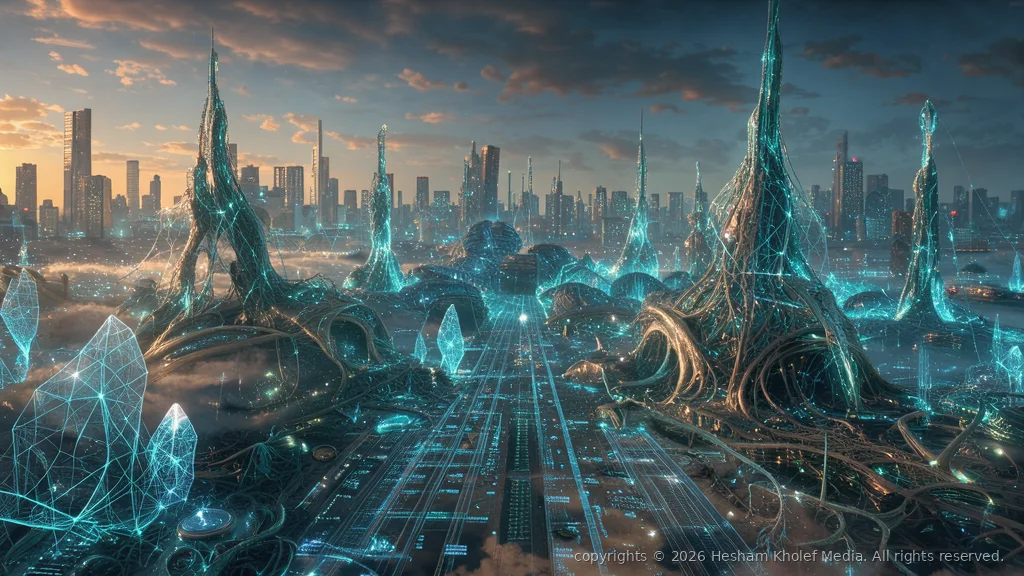
The Inflection Point: From Pattern Matching to Reasoning

The history of artificial intelligence has been written in distinct eras. The symbolic era gave us logic and rules. The statistical era brought machine learning and pattern recognition. The deep learning era delivered perception — vision, speech, translation. But the era now dawning is fundamentally different: it is the era of reasoning, agency, and synthesis.
Large language models have crossed a threshold. They no longer merely predict the next token; they decompose problems, plan multi-step workflows, invoke tools, and iterate toward goals. This shift — from passive completion to active completion with intent — marks the birth of agentic AI. Systems like Devin, AutoGPT, and the emerging class of computer-using agents demonstrate that intelligence can now operate in the world, not just on text.
The Architecture of Agentic Systems
What distinguishes an agent from a model? Three pillars: memory, tool use, and autonomy.
Memory transforms a stateless predictor into a continuous collaborator. Vector databases, knowledge graphs, and episodic recall allow agents to maintain context across days, learn from failures, and build institutional knowledge. Tool use extends cognition into action — APIs, browsers, code interpreters, robotics. Autonomy closes the loop: the agent observes, decides, acts, and reflects without human micromanagement.
The most profound shift is not that AI can code or write — it's that AI can now manage the process of coding and writing, recruiting specialized sub-agents, verifying outputs, and iterating until the objective is met.
The Economic Reformation

Every prior technological revolution — steam, electricity, computing — reorganized labor. The agentic AI revolution reorganizes cognition itself. Knowledge work, long considered automation-resistant, faces its first genuine displacement pressure. But displacement is only half the story.
The countervailing force is amplification. A single developer with an agent swarm can now prototype, test, document, and deploy systems that previously required teams of ten. A solo researcher can simulate clinical trials, synthesize literature across languages, and generate hypotheses at superhuman speed. The marginal cost of intelligence is approaching zero; the marginal value of direction — knowing what to build and why — is soaring.
Self-Hosted Sovereignty: The Infrastructure Counter-Movement
As frontier models centralize in hyperscale clouds, a parallel movement grows: self-hosted, open-weight intelligence. Models like Llama 3, Nemotron 3 Ultra, and Qwen 2.5 now rival proprietary systems on benchmarks while running on consumer hardware. Projects like Ollama, vLLM, and llama.cpp democratize inference.
This matters profoundly. Agentic workflows demand privacy, latency guarantees, and cost predictability that cloud APIs cannot always provide. A self-hosted agent swarm operating on a private VPS cluster — with local vector stores, air-gapped tool access, and zero egress fees — represents compute sovereignty. The same infrastructure that hosts your website can now host your intelligence.
# Deploy a local agent stack on a VPS
docker run -d --name ollama -v ollama:/root/.ollama -p 11434:11434 ollama/ollama
docker exec ollama ollama pull llama3.1:70b
docker exec ollama ollama pull nemotron3:ultra

# Serve with vLLM for high-throughput agent inference
docker run --gpus all -p 8000:8000 vllm/vllm-openai:latest \
  --model meta-llama/Llama-3.1-70B-Instruct --tensor-parallel-size 2
The Synthetic Society: Culture, Governance, and Identity

Beyond economics lies culture. Synthetic media — video, audio, 3D worlds generated on demand — dissolves the scarcity of creative production. Anyone can direct a film, compose a symphony, or architect a game world. The bottleneck shifts from execution to curation and vision.
Governance struggles to keep pace. Attribution, liability, and rights frameworks designed for human authors crumble under synthetic abundance. Who owns the output of an agent swarm trained on humanity's collective corpus? The answer will shape whether the coming era concentrates power or distributes it.
Identity itself becomes fluid. Digital twins — agents that reason, communicate, and negotiate on your behalf — will attend meetings, negotiate contracts, and maintain relationships while you sleep. The boundary between "me" and "my agents" blurs.
"The question is not whether artificial intelligence will transform civilization — it is whether we will architect that transformation with intention, or inherit it by default."
— Hesham Kholef
Horizons: The Next Decade
Three trajectories define the world to come:
- Convergent Intelligence: Multimodal foundation models unifying vision, language, action, and robotics into single systems that perceive and act in physical reality.
- Recursive Self-Improvement: Agents that write, test, and deploy better versions of themselves — compressing the innovation cycle from years to days.
- Ambient Computation: Intelligence woven into the environment — walls that listen, surfaces that compute, spaces that anticipate — making the interface disappear entirely.
Building the Future on Purpose
The new era of AI is not a wave that happens to us. It is a substrate we build upon. Every line of open-source code, every self-hosted model, every ethical framework, every educational initiative — these are the load-bearing walls of the world to come.
The tools are here. The models are here. The infrastructure is commoditizing rapidly. What remains scarce is clarity of purpose: the wisdom to direct this unprecedented cognitive abundance toward human flourishing rather than mere engagement optimization.
That clarity begins with each of us — developers, artists, entrepreneurs, parents, citizens — asking not "what can AI do?" but "what should we build with it?"
Comments (0)