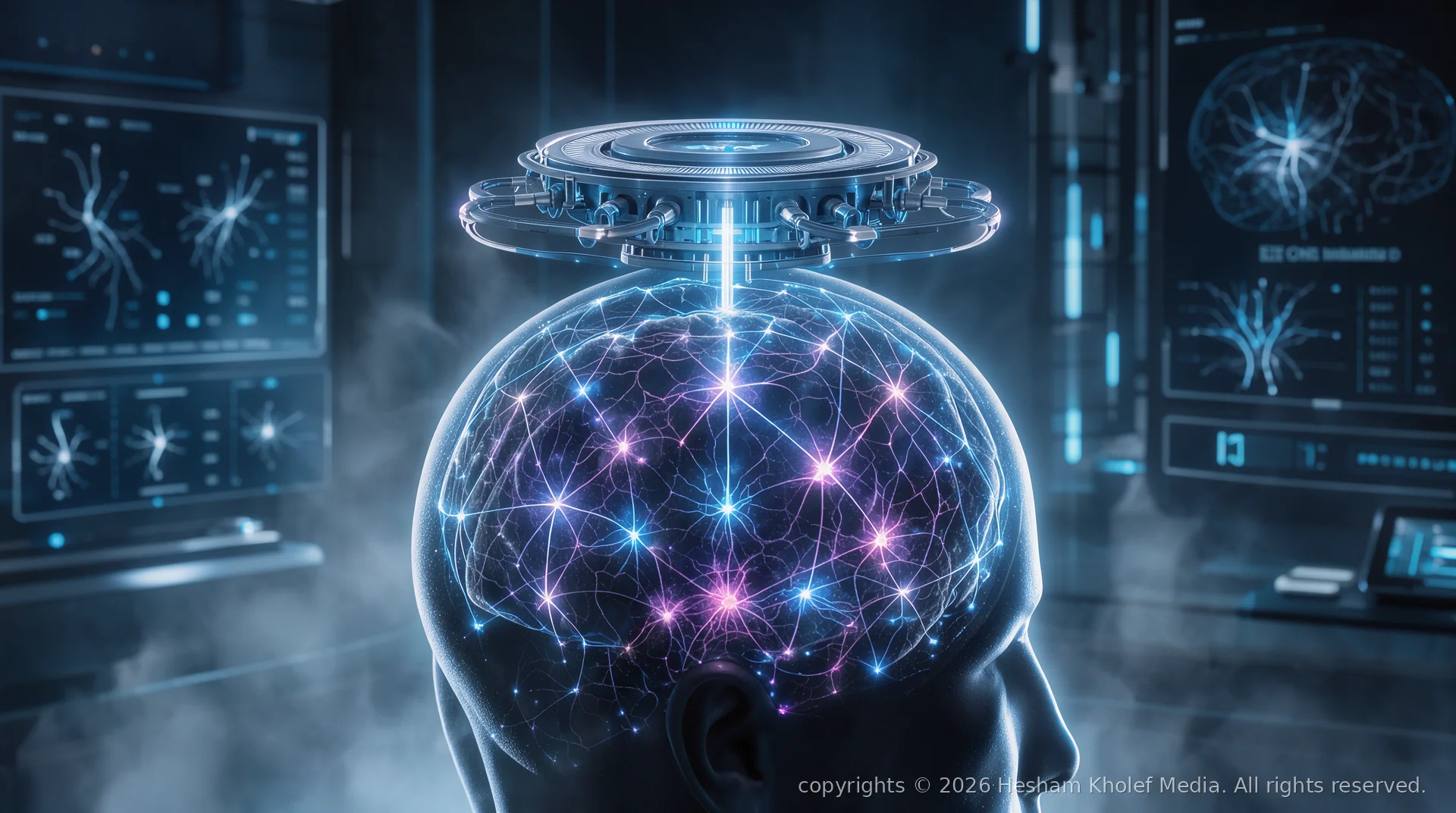
The Dawn of Direct Neural Communication
For most of human history, the boundary between mind and machine has been absolute: we think, and then we move a finger, press a key, speak a word. Every tool we have ever built — from the printing press to the smartphone — has stood outside the skull, waiting for our clumsy signals to reach it. Neuralink, and the broader field of brain-computer interfaces (BCIs), proposes something radically different: a direct, high-bandwidth bridge between the biological brain and digital systems.
This is not a distant fantasy anymore. In 2024, Neuralink's first human patient, Noland Arbaugh, successfully used the N1 implant to control a computer cursor with his thoughts alone — playing chess, browsing the web, and communicating — entirely through neural signals. What began as a research curiosity in the 1970s has become one of the most consequential technologies of the 21st century.
"The goal is not to replace the mind, but to give it a louder voice — a direct line to the machines that can extend what it can do."
— Hesham Kholef
Inside the N1 Chip: Engineering at the Scale of Neurons
At the heart of Neuralink's system is the N1 implant — a coin-sized device containing 1,024 electrodes distributed across 64 ultra-thin threads, each thinner than a human hair. A custom surgical robot, capable of inserting these threads with micron-level precision while avoiding blood vessels, places them into the motor cortex — the region of the brain that plans and executes movement.
The chip reads neural "spikes" — the electrical signatures of individual neurons firing — and translates them into digital commands in real time. A wireless, battery-powered external pod processes these signals and transmits them via Bluetooth to a paired device. The entire pipeline, from thought to action, happens in milliseconds.
What the First Patients Can Actually Do Today
Current capabilities are focused on restoring agency to people with paralysis. Early trial participants have demonstrated the ability to:
- Move a cursor and click with thought alone, at speeds approaching able-bodied mouse use.
- Type using on-screen keyboards, enabling text-based communication for people who cannot speak or move.
- Play video games, browse the internet, and use creative applications — experiences that restore not just function, but joy and autonomy.
- Control robotic arms and digital assistants, laying the groundwork for physical-world interaction.
These are not incremental improvements; for a person with quadriplegia, thought-controlled computing represents a categorical leap in independence.
The first generation of BCIs is therapeutic — designed to restore lost function. But the same interface that lets a paralyzed person type can, in principle, let anyone type. The line between therapy and enhancement is thinner than it appears.
What to Expect in the Next Five Years

The roadmap ahead is ambitious. Neuralink has publicly stated goals that include restoring vision (the "Blindsight" implant), enabling speech restoration for people who have lost the ability to talk, and eventually restoring full-body movement for spinal cord injury patients. Beyond Neuralink, competitors like Synchron, Paradromics, and Kernel are advancing their own approaches — some using stent-like devices threaded through blood vessels, others using non-invasive headsets.
Restoring Sight and Speech
Vision restoration works by bypassing damaged eyes entirely: a camera feeds visual information directly into the visual cortex, creating artificial sight. Early versions will offer low-resolution, black-and-white perception — enough to detect shapes, motion, and text. Speech restoration targets the neural pathways involved in vocalization, potentially letting people who are "locked in" communicate at natural conversational speed.
From Therapy to Augmentation
Once the safety and longevity of implants are proven in clinical populations, the technology will inevitably migrate toward enhancement. Imagine accessing information, communicating, or controlling devices at the speed of thought — no keyboard, no screen, no voice. Memory augmentation, direct brain-to-brain communication, and seamless integration with AI systems are all plausible destinations on this trajectory.
The Hard Problems: Safety, Longevity, and the Immune Response
None of this is trivial. The brain is the most delicate organ in the body, and it does not welcome foreign objects. Key challenges include:
- Biocompatibility: The body's immune response can form scar tissue around electrodes, degrading signal quality over time. New materials and flexible electrode designs are being developed to minimize this.
- Longevity: An implant must function reliably for years or decades. Battery life, wireless charging, and the ability to upgrade hardware without repeat brain surgery are active engineering frontiers.
- Signal fidelity: Reading from thousands of neurons is only the beginning; the real challenge is decoding intent reliably from noisy biological signals, a problem at the intersection of neuroscience and machine learning.
- Security: A device that reads and writes neural signals is, by definition, hackable. Protecting the brain from unauthorized access will require cryptographic security at a level we have never needed before.
The Ethical Horizon: Who Gets Access, and Who Decides?
Perhaps the most important questions are not technical but human. If neural implants can enhance memory, focus, or mood, who gets them? Will they become a luxury available only to the wealthy, deepening social inequality? What happens to privacy when a device can, in principle, read emotional states or intentions? And at what point does augmentation become a new form of coercion — an expectation rather than a choice?
Regulators are only beginning to grapple with these questions. The FDA's oversight of Neuralink's trials marks the start of a regulatory framework that will need to evolve as fast as the technology itself. International coordination will matter enormously, because neural technology will not respect borders.
The most profound shift will not be technological but cognitive: when thinking becomes indistinguishable from communicating with a machine, the boundary between "my thought" and "the system's response" begins to blur. We will need new language — and new ethics — for that world.
Human-AI Symbiosis: The Long Arc
Looking further ahead — a decade, two decades — the trajectory points toward something science fiction has long imagined: a genuine symbiosis between human cognition and artificial intelligence. Not AI replacing humans, but AI extending them — a layer of machine intelligence woven into biological thought, accessible as naturally as memory itself.
This is the vision that drives companies like Neuralink: not merely to heal the broken, but to expand the possible. Whether that future arrives as liberation or as a new kind of dependence depends on the choices we make now — in labs, in regulatory agencies, and in our own imaginations.
Conclusion: The Interface Is the Message
Neuralink and its peers are doing something unprecedented: they are turning the skull from a boundary into a doorway. What we find on the other side — restored sight, restored speech, restored movement, and eventually augmented cognition — will reshape medicine, work, creativity, and what it means to be human.
The technology is young, the risks are real, and the ethical questions are unresolved. But the direction of travel is clear. The interface between mind and machine is no longer a metaphor. It is hardware — and it is here.
Comments (0)