The End of Static Workflows

For two decades, enterprise automation meant scripting fixed sequences: if this, then that; extract, transform, load; trigger, approve, notify. These workflows were deterministic, auditable, and — critically — brittle. A single upstream schema change, an unhandled edge case, or a new regulatory requirement could cascade into days of engineering firefighting. The paradigm assumed a knowable, stable world. That assumption has expired.
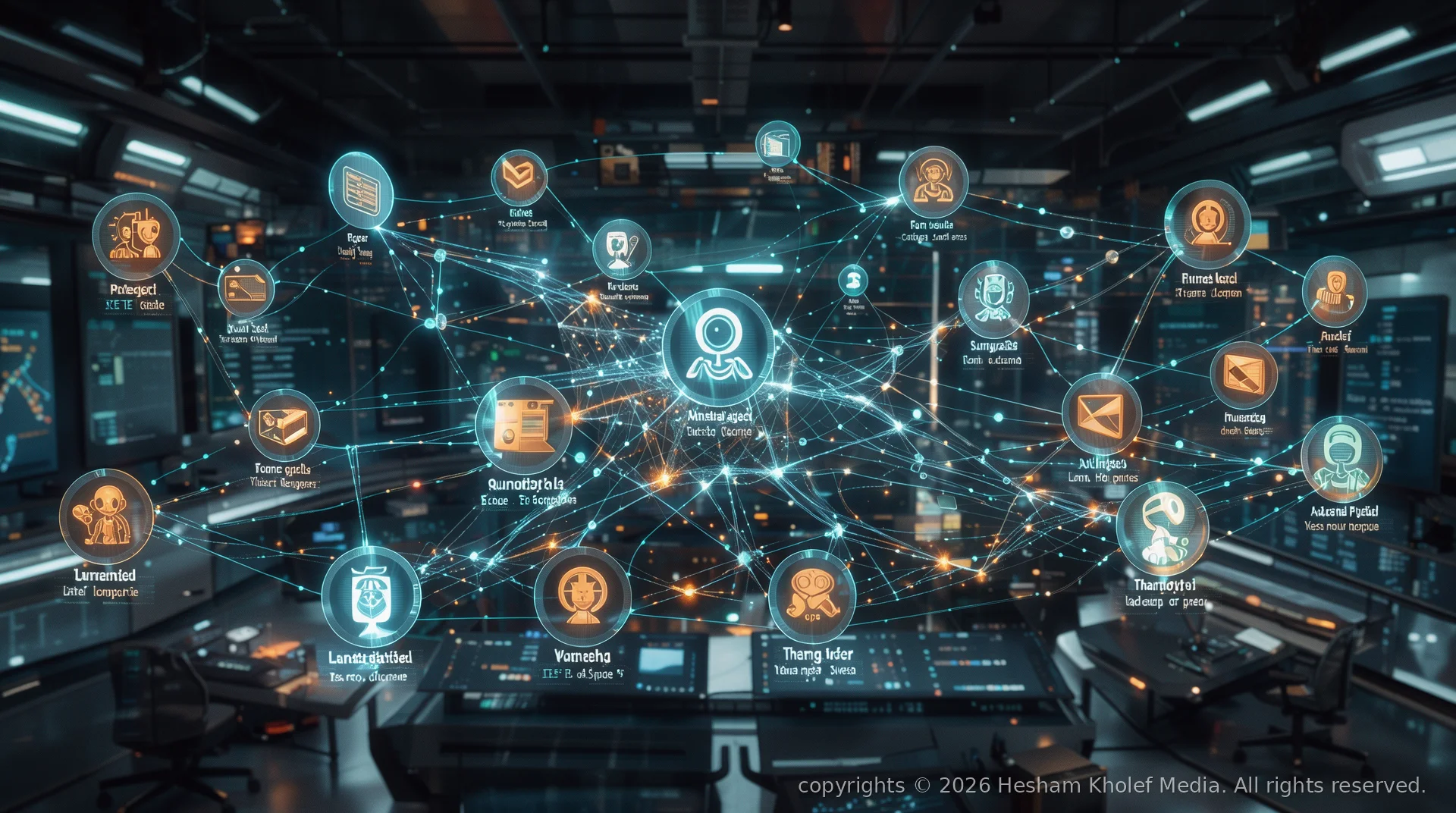
Agentic AI introduces a fundamentally different compute primitive: an autonomous loop that perceives context, selects tools, executes actions, evaluates outcomes, and replans — all without a human in the loop for every micro-decision. The agent is the workflow. It writes its own control flow at runtime, guided by objectives and guardrails rather than hardcoded steps.
Why 2025 Is the Inflection Point

Three independent curves have collided to make this shift inevitable:
1. Inference Costs in Freefall
The cost per million tokens for frontier models has dropped by two orders of magnitude since 2022. What cost $60 per million tokens now costs cents. This economic collapse means agents can afford to "think" — running dozens of reasoning steps, tool calls, and self-correction loops per task — without triggering budget alarms. The unit economics of autonomous operation have crossed the viability threshold.
2. Orchestration Stacks Have Matured
Frameworks like LangGraph, AutoGen, CrewAI, and enterprise platforms from Microsoft, Google, and AWS now provide production-grade primitives: persistent state, human-in-the-loop checkpoints, observability, eval harnesses, and multi-agent coordination. The "plumbing" problem — memory, tool routing, error recovery, versioning — is largely solved. Teams no longer build orchestration; they configure it.
3. Governance Has Hardened
Regulatory frameworks (EU AI Act, US Executive Orders, sector-specific guidance) have moved from vague principles to concrete requirements: audit trails, explainability, data lineage, and human oversight checkpoints. Agent platforms now bake these in natively — structured decision logs, tool-call provenance, policy-as-code guardrails. Compliance is no longer a blocker; it's a configuration layer.
"The enterprise that treats agents as 'smart scripts' will build fragile demos. The enterprise that treats agents as a new compute primitive — with its own runtime, observability, and governance layer — will build the next generation of operating systems for knowledge work."
— Hesham Kholef
Where Agents Are Replacing Workflows First
Software Engineering: From Copilot to Autonomous Developer
Code generation was the beachhead. Now agents own full lifecycle tasks: writing specs, scaffolding repos, implementing features, running tests, opening PRs, responding to review comments, and deploying to staging. Companies report 40–70% cycle-time reductions on routine features. The agent doesn't just complete code; it completes work.
Finance & Operations: Closing the Books Without the Close
Reconciliation, variance analysis, anomaly detection, and narrative generation — traditionally a two-week sprint of spreadsheets and emails — are becoming continuous, agent-driven processes. Agents pull from ERPs, banks, and data warehouses, flag discrepancies in real time, draft commentary, and route exceptions to humans only when judgment is required. The "monthly close" dissolves into a continuous close.
Customer Experience: Resolution Without Escalation
First-generation chatbots deflected with FAQs. Agentic CX systems diagnose, act (refund, rebook, provision, cancel), verify resolution, and follow up — across channels, with full context persistence. Early adopters report 60%+ full-resolution rates without human handoff, and CSAT scores matching or exceeding human-only queues.
Data & Analytics: Self-Service That Actually Serves
Instead of filing a ticket and waiting weeks for a dashboard, business users describe questions in natural language. Agents translate intent to SQL, execute against governed data products, visualize results, explain anomalies, and schedule recurring deliveries. The semantic layer becomes executable.
The winners in 2025 will not be those with the "best model." They will be those who build the agent runtime — the control plane that governs how agents access data, invoke tools, coordinate with each other, and remain auditable. Model access is commoditized; the runtime is the moat.
The Architecture of an Agent-Native Enterprise

Adopting agentic AI is not a point-solution purchase. It requires a platform shift across four layers:
1. Agent Runtime & Control Plane
A unified substrate for deploying, versioning, monitoring, and governing agents. This includes: identity & permissions (agent-to-agent, agent-to-human, agent-to-system), tool registries with typed schemas, execution sandboxes, cost budgets, and policy enforcement points. Think Kubernetes for agents.
2. Knowledge & Memory Fabric
Agents need long-term, queryable memory: vector stores for semantic retrieval, graph databases for relationship reasoning, and structured stores for factual grounding. This fabric must support multi-tenancy, lineage, and TTL policies. RAG is not a feature; it's infrastructure.
3. Evaluation & Observability
You cannot manage what you cannot measure. Agent evals must cover: task success rates, tool selection accuracy, hallucination rates, latency distributions, cost per resolution, and safety violations. Continuous eval pipelines — running synthetic and production traffic — are the new CI/CD.
4. Human-AI Interaction Layer
Escalation UIs, approval dashboards, feedback loops, and "shadow mode" deployments where agents propose but humans dispose. The goal is progressive autonomy: start with human-in-the-loop, graduate to human-on-the-loop, arrive at human-out-of-the-loop for bounded domains.
Risks and the Hardening Path
The shift is not without peril. Prompt injection, tool misuse, cascading failures in multi-agent systems, and opaque decision chains remain real. But the industry is hardening fast: formal verification of tool-call chains, sandboxed execution with eBPF-level isolation, differential privacy for memory, and standardized agent-to-agent protocols (A2A, MCP) that enable composability without vendor lock-in.
Enterprises that wait for "zero risk" will cede the market to those who build governed autonomy incrementally — starting with low-stakes, high-volume tasks, instrumenting heavily, and expanding the autonomy envelope as evidence accumulates.
Conclusion: The New Default
Static workflows defined the last era of enterprise software. Agentic workflows — autonomous, tool-using, self-correcting, governed — define the next. The platform shift of 2025 is not about a better chatbot. It is about a new operating model for knowledge work: one where software doesn't just execute instructions, but pursues outcomes.
The organizations that internalize this shift — building agent runtimes, not just agents; investing in evaluation, not just prompts; treating governance as architecture, not afterthought — will compound advantage faster than any previous technology wave. The agents are ready. The infrastructure is ready. The only remaining variable is organizational will.
Comments (0)